
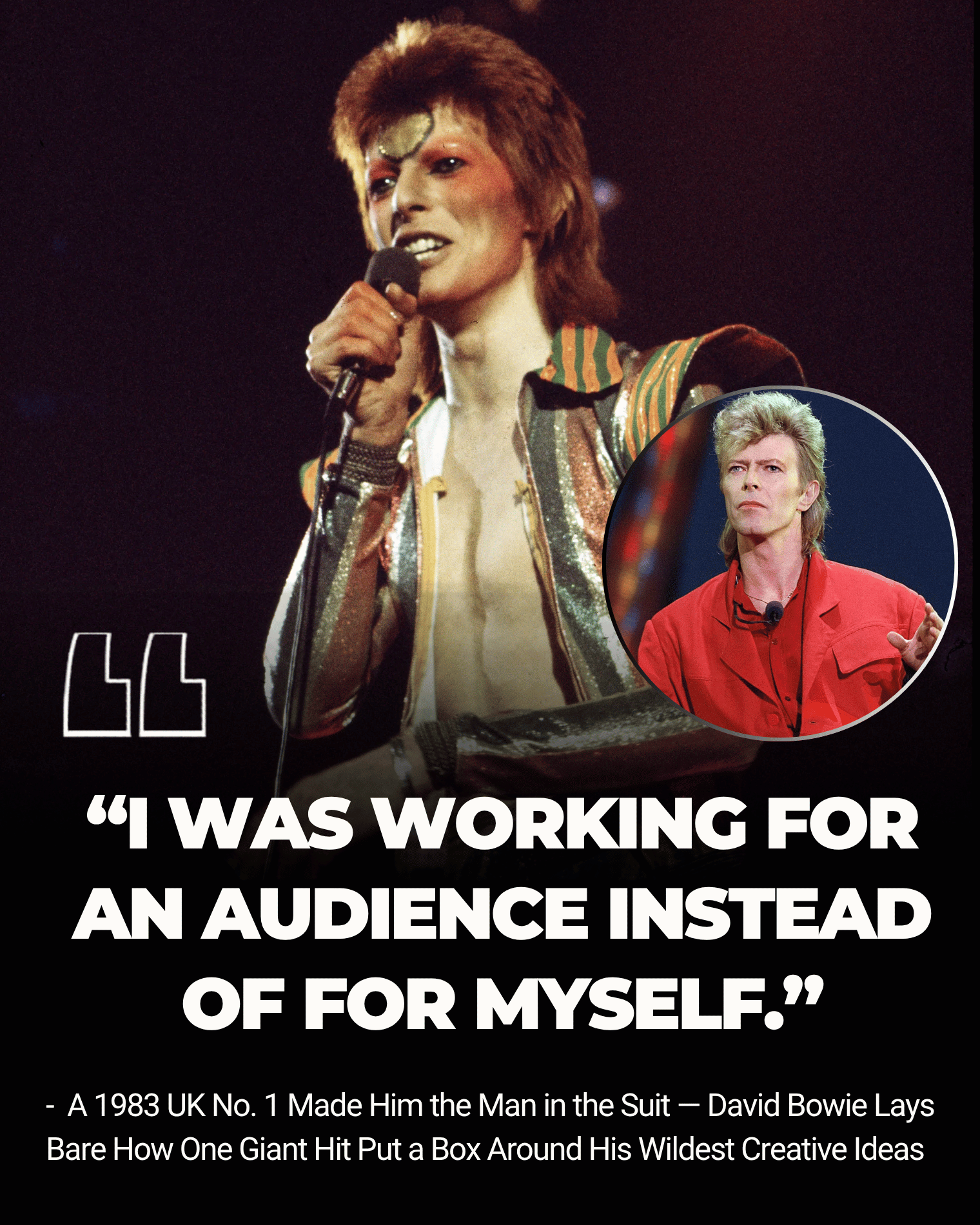
David Bowie did not deny the earthquake caused by “Let’s Dance,” the sleek 1983 smash that shot to No. 1 in the UK.
But behind the sharp tailoring, stadium-sized hooks, and worldwide adoration, Bowie later saw a dangerous trade taking shape around his own name.
The man who had spent decades mutating into impossible new characters suddenly felt audiences wanted only one version of him: the polished superstar in the suit.
In a 1995 conversation with Interview, Bowie gave the unease a brutally clear voice: “I was working for an audience instead of for myself.”
Those ten words landed like a confession from an artist who had built his legend by refusing to stay comfortable for anyone.
For Bowie, “Let’s Dance” was not simply a massive hit; it became the glossy blueprint everyone expected him to repeat.
The single’s colossal success brought a level of mainstream visibility that many artists spend entire careers chasing without ever touching.
Yet Bowie saw the cost of that crossover in the way his public image hardened around a neat, highly marketable silhouette.
Suddenly, the wild inventor behind Ziggy Stardust, the Thin White Duke, Berlin experiments, and musical left turns was being reduced to a dependable pop machine.
That was the trap: the bigger the hit became, the narrower the public’s idea of David Bowie seemed to grow.
He believed people were seeing the immaculate suit, the dance-floor sheen, and the commercial confidence, while missing the creative chaos underneath.
His fear was not that success had made him irrelevant; it was that success had made his strangest instincts seem inconvenient.
Bowie had always treated reinvention as more than a publicity stunt, turning uncertainty, risk, and artistic discomfort into fuel.
So when the industry pushed him toward repeating a bright, accessible formula, the pressure hit a nerve deeper than ordinary chart anxiety.
He was not rejecting his own triumph; he was fighting to make sure one triumphant chapter did not become the cage around every chapter after it.
The irony is almost cinematic: “Let’s Dance” made Bowie larger than ever, while leaving him desperate to escape the version of himself it sold.
The suited pop icon may have conquered the world, but the restless artist inside him was already looking for the nearest exit.
And that is why Bowie’s later reflection still stings—because even a No. 1 can feel like a locked door when everyone wants you to stay inside.