
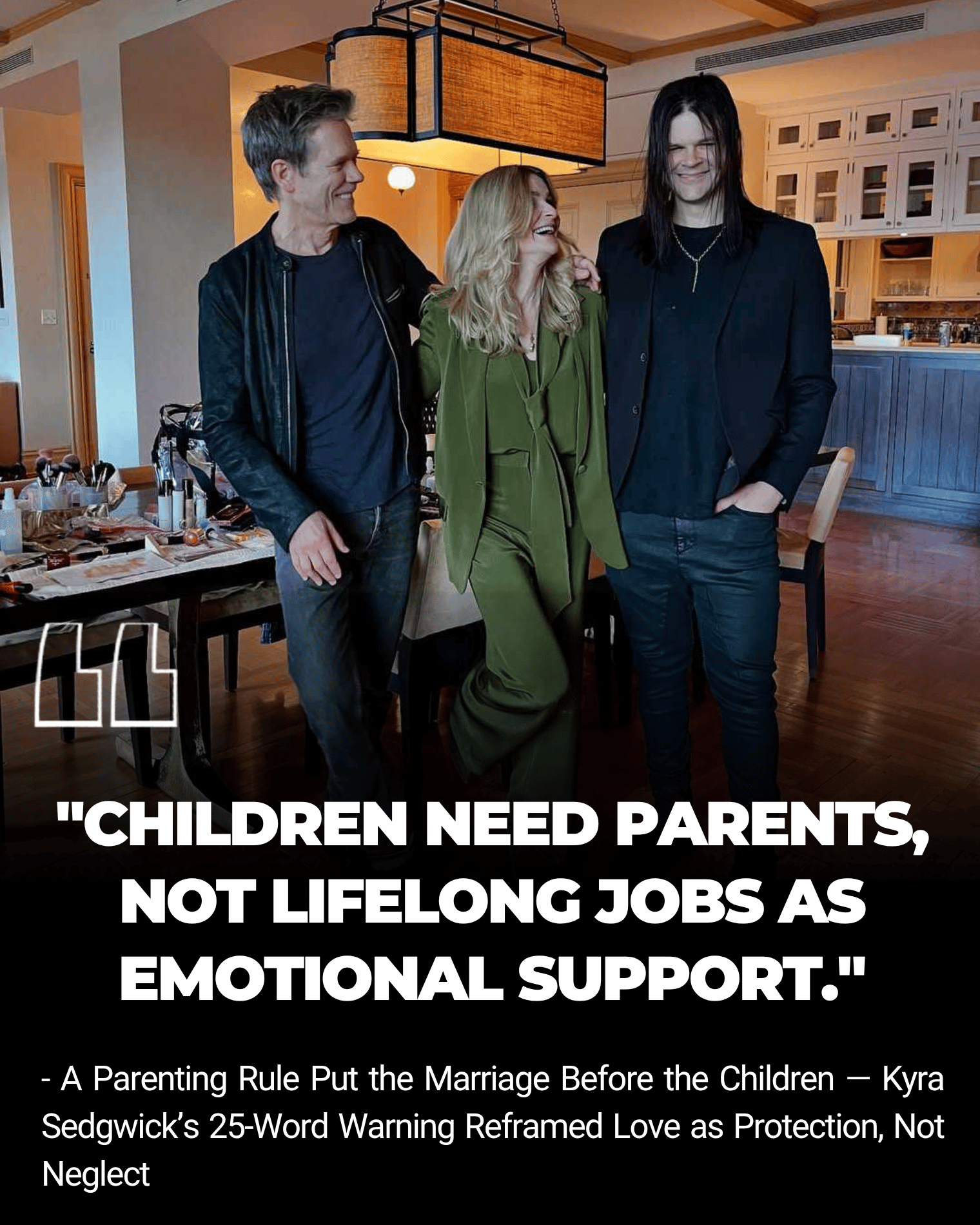
A Parenting Rule Put the Marriage Before the Children — Kyra Sedgwick’s 25-Word Warning Reframed Love as Protection, Not Neglect challenged one of parenting’s most emotionally loaded assumptions.
In a 2008 Redbook interview, Kyra Sedgwick explained why her marriage to Kevin Bacon could not simply disappear beneath the demands of raising their children. Her argument was direct: a healthy family needed a strong partnership at its center.
“Kids should know that your needs are important, because if they think your happiness lies only in them, that’s a lot of pressure on them,” Sedgwick said. The warning immediately turned an ordinary discussion about couple time into a deeper statement about emotional responsibility.
Parents are often praised for sacrificing everything, placing their children first in every moment and treating personal needs as evidence of selfishness. Sedgwick pushed back against that standard without suggesting that children should ever feel ignored or unloved.
Her point was not that Travis and Sosie mattered less than the marriage. It was that children should never be forced to believe their parents’ entire emotional stability depends on them.
That kind of pressure can hide inside devotion. A child repeatedly told that they are a parent’s whole world may eventually feel responsible for keeping that world from collapsing.
Sedgwick presented her marriage as the family’s foundation rather than a rival competing for attention. Protecting that bond meant preserving the structure surrounding the children, even when parenting demands threatened to consume every available moment.
She and Bacon had already built one of Hollywood’s most enduring relationships, but her answer avoided presenting marriage as effortless. Staying connected required intention, time, and a willingness to remember that parents remain individuals and partners after children arrive.
The statement also rejected the fantasy that good mothers should erase themselves. Sedgwick defended the right to maintain adult needs, personal happiness, and romantic connection without apologizing for failing some impossible standard of total self-sacrifice.
Her reasoning carried an unexpected tenderness. By refusing to make the children the sole source of happiness, she was freeing them to grow without believing they owed their parents constant closeness, achievement, or emotional reassurance.
That distinction transformed couple time from an indulgence into a form of protection. Dinner alone, private conversations, and attention to a marriage were not acts of abandonment; they were investments in the family’s long-term stability.
Sedgwick’s warning also exposed how easily love can become a burden when boundaries disappear. Children need devotion, but they also need permission to become independent without fearing that their parents will be emotionally destroyed by that separation.
Her parenting rule sounded controversial only because modern family culture often confuses exhaustion with virtue. Sedgwick offered a calmer alternative: love the children deeply, strengthen the partnership deliberately, and never make young people carry adult happiness.
What appeared to be a decision to put marriage first was ultimately something more protective. She was not choosing her husband over her children; she was refusing to place the weight of an entire family’s emotional life on their shoulders.