
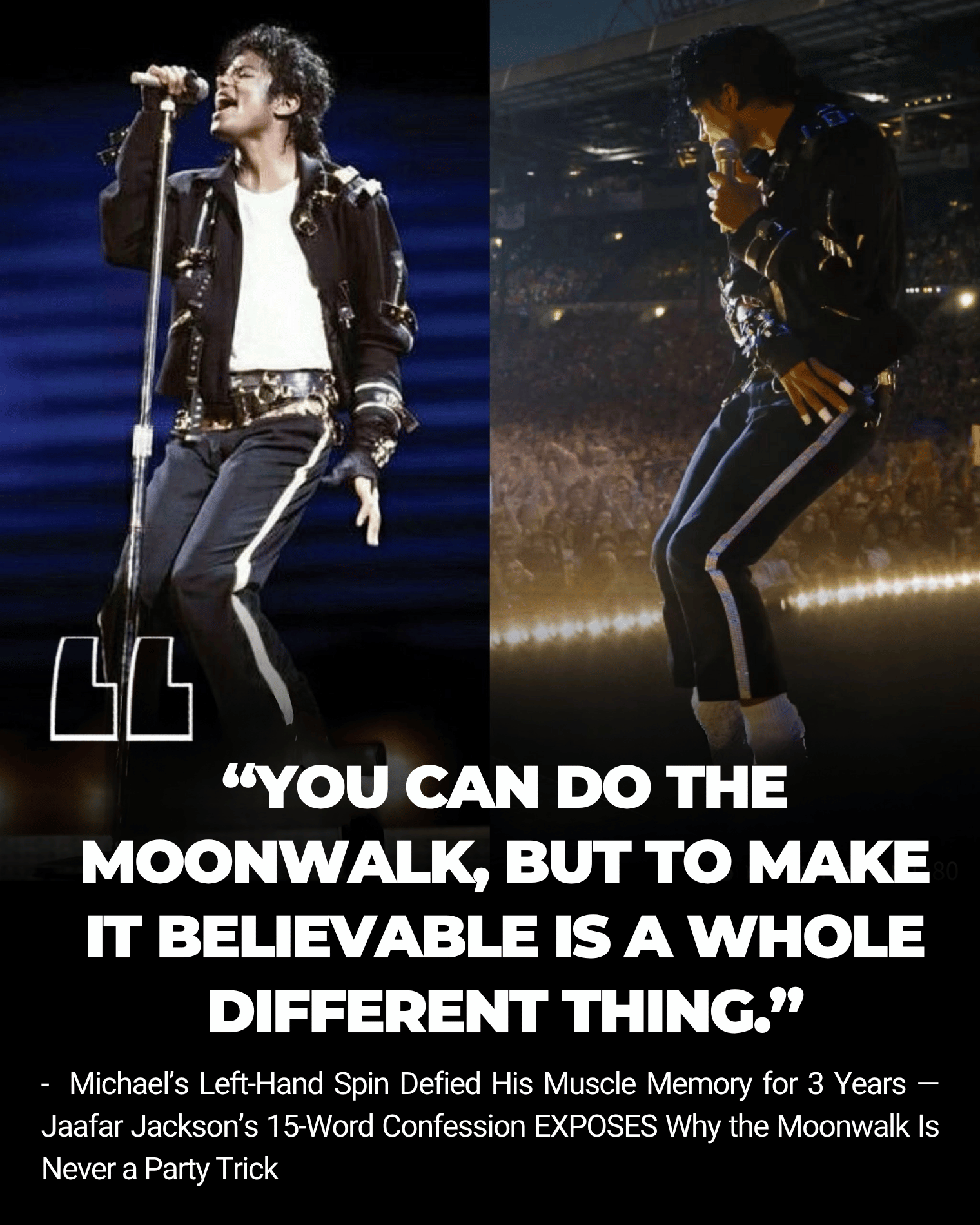
Jaafar Jackson did not walk into Michael thinking family resemblance could carry him through the most scrutinized moves in pop-history.
The actor had Michael Jackson’s legacy waiting on every count, every heel glide, every pause, and one signature spin nearly exposed exactly how brutal that pressure became.
“It took a lot of training,” Jaafar admitted, describing a process that demanded far more than learning famous choreography from the outside.
His most stubborn enemy was not the moonwalk itself, but the leftward spin that Michael made seem as effortless as breathing under stadium lights.
Jaafar’s natural balance pulls him to the right, meaning his body instinctively resisted the direction Michael’s movement demanded night after night.
That mismatch turned a few seconds of iconic choreography into a three-year battle between muscle memory, discipline, and the impossible standards attached to the Jackson name.
The result was not simply a performer copying a legend’s silhouette, but a young actor forcing his own body to understand another artist’s rhythm.
And that is where the moonwalk stopped being a flashy party move and became something much more serious, almost unnervingly personal.
“You can do the moonwalk, but to make it believable is a whole different thing,” Jaafar said, delivering the kind of confession that cuts through all the imitation hype.
Because anyone can slide backward across a polished floor for a few seconds, especially with cameras rolling and applause already waiting.
But Michael Jackson never sold the moonwalk as a stunt; he made it look like gravity had briefly changed its mind for him.
That illusion came from timing, posture, attitude, stillness, and the emotional electricity behind every movement, not just the famous glide itself.
For Jaafar, getting close meant revisiting those details until his own instincts stopped interrupting the shape, speed, and feeling of Michael’s performance.
The upcoming film’s recreations of moments like “Bad” therefore carry a different kind of pressure, where precision must serve emotion instead of becoming empty mimicry.
One wrong spin can look like choreography; one believable spin can make audiences forget they are watching someone retrace another man’s history.
Jaafar’s three-year grind reveals the truth behind the white socks, black shoes, and supernatural footwork fans have replayed for generations.
Michael Jackson made the impossible look playful, but Jaafar’s struggle proves the legend’s movement was built from obsession, control, and an almost frightening attention to detail.
The moonwalk may still ignite every dance floor it touches, but in Michael, it has to do something harder: convince the world that magic can have weight.