
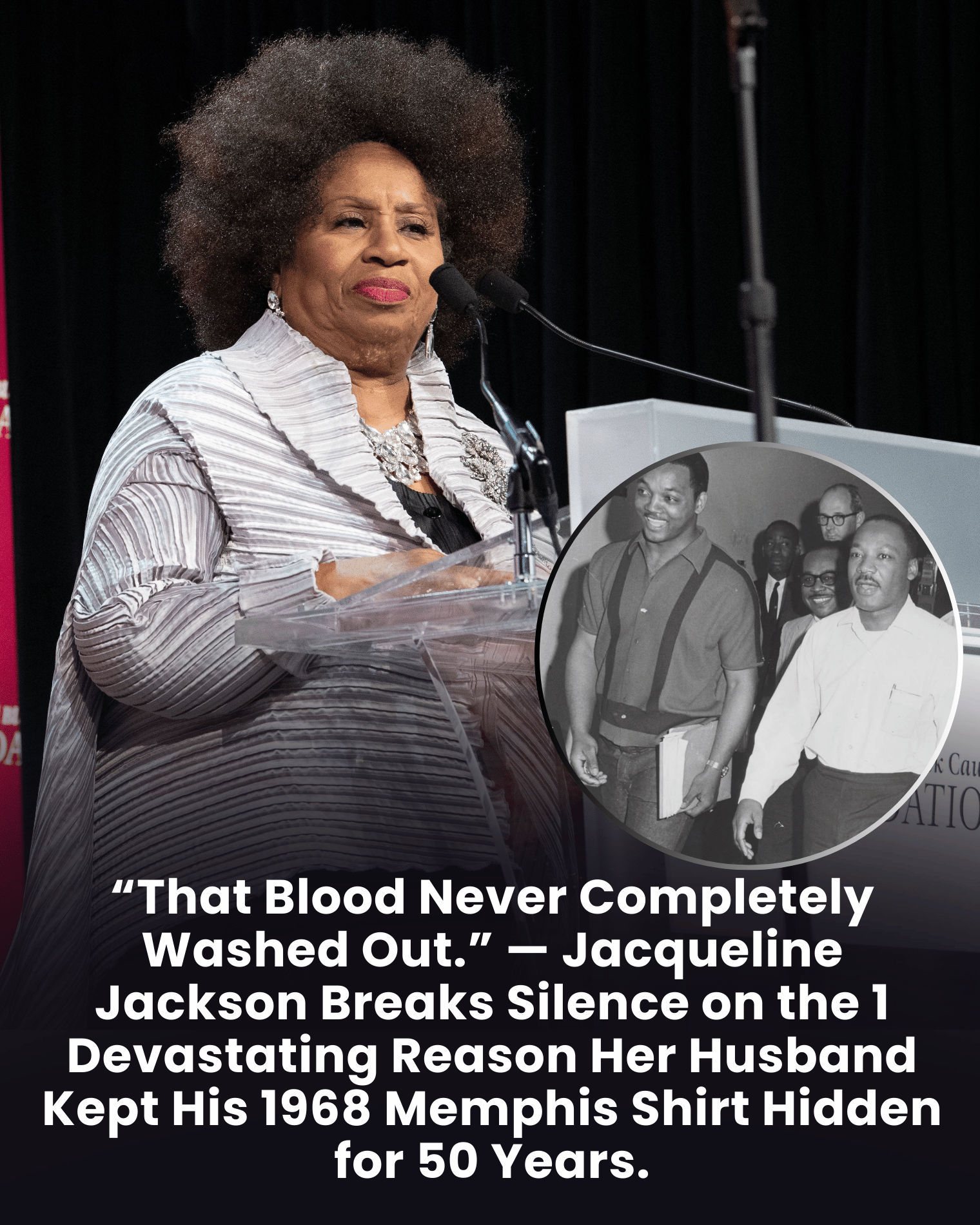
For decades, Jacqueline Jackson quietly carried a painful memory from one of the darkest moments in American history. The event was not only a national tragedy but also a deeply personal trauma for her husband, civil rights leader Jesse Jackson. In rare reflections, she revealed how the events surrounding the assassination of Martin Luther King Jr. in 1968 left a permanent mark on their family.
On April 4, 1968, King was standing on the balcony of the Lorraine Motel in Memphis when a gunshot rang out, killing the civil rights icon and sending shockwaves through the nation. Jackson, who was only 26 years old at the time, had been working closely with King as part of the civil rights movement. He was present at the motel when the shooting occurred and rushed to the scene in the immediate aftermath.
According to Jacqueline Jackson, the moment left her husband shaken in a way that few people truly understood. When he returned home to Chicago shortly after the tragedy, he was still wearing the same shirt he had on that day—stained with King's blood. The sight was deeply unsettling for the family. For days, Jesse refused to wash it, as though the garment had become a painful but sacred reminder of what had happened.
The bloodstained shirt became a symbol of the enormous emotional burden he carried. Jacqueline later explained that the trauma of witnessing the assassination up close was something Jesse rarely discussed publicly. Instead, he internalized the grief, allowing it to shape his sense of purpose in the years that followed.
The assassination itself, known historically as the Assassination of Martin Luther King Jr., marked a turning point for the civil rights movement. Across the United States, cities erupted in grief, protests, and calls for justice. For Jackson personally, the tragedy created a sense of unfinished work—a belief that the mission King had championed could not end with his death.
That sense of responsibility would later define Jackson's career. Throughout the 1970s and 1980s, he emerged as one of the most prominent civil rights and political leaders in the country. His activism expanded into voter registration campaigns aimed at increasing political participation among minority communities.
The momentum eventually led to Jackson's historic presidential runs in 1984 and 1988. Though he did not win the Democratic nomination, his campaigns transformed American politics by mobilizing millions of voters who had previously been excluded from the political process. His efforts helped register more than two million new minority voters during that era, dramatically expanding political engagement in communities that had long faced barriers.
For the Jackson family, those achievements were never separate from the memory of that day in Memphis. Jacqueline Jackson has said that the haunting image of the Lorraine Motel balcony remained a constant presence in her husband's life. The grief that followed King's death did not fade with time; instead, it hardened into determination.
The shirt Jesse Jackson once refused to wash eventually became more than a relic of tragedy. It represented a moment when personal sorrow transformed into a lifelong commitment to justice. For those closest to him, it was a reminder that history is not only written in speeches and movements, but also in the quiet, painful memories that drive individuals to keep fighting long after the cameras disappear.